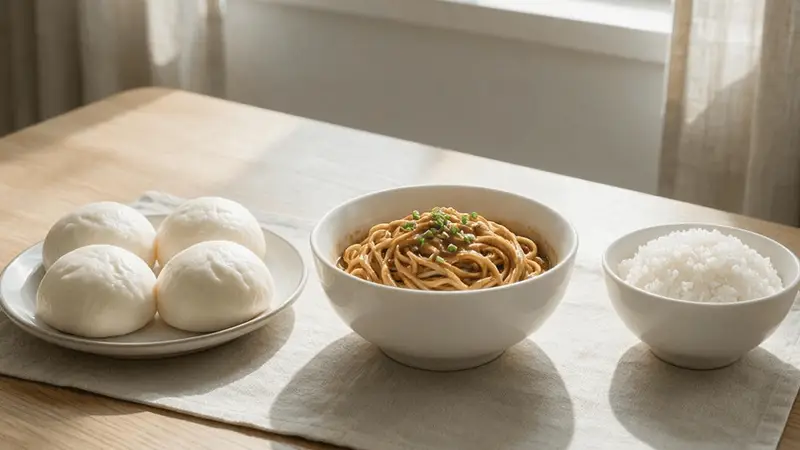
Core conclusions at a glance: When it comes to weight equivalence, white rice leads in the fastest blood sugar rise (GI≈83), followed by white steamed buns (GI≈88, though actual consumption volumes usually are larger), and white noodles come in slightly slower (GI≈81). What truly determines blood sugar isn't just "how fast it rises," but rather "how much carb is consumed"—all three refined staple foods contain about 70% carbohydrates, making them high-risk choices for diabetic patients. The key to blood sugar control lies in selecting the right type of staple food and managing the total amount carefully.
01. A Real-Life Puzzle from a Diabetic Patient's Family Member
Zhang Aijie, 62, has been living with type 2 diabetes for eight years. Her daughter Xiao Li, who works far away, always reminds her over the phone: "Mom, limit your intake of staple foods, especially white rice, it spikes blood sugar quickly." But Zhang Aijie has long harbored a question: Are steamed buns and noodles safer than rice?
This question is almost universally asked by diabetics and their families. In China, rice, noodles, and steamed buns serve as the three cornerstones of the dining table. Southerners can't live without rice daily, northerners prefer noodle dishes, and steamed buns often form the staple of breakfast across many households. Yet once diagnosed with diabetes, these seemingly innocent foods turn into "sweet adversaries."
Some argue, "Noodles cause a faster blood sugar spike because they digest and absorb easily," while others claim, "Steamed buns, being fermented, have an even stronger effect." Then there's the assertion, "White rice is the most dangerous—一碗等于一碗糖." Conflicting opinions abound, yet which one holds the truth?
In this article, we'll delve into the fundamental principles of nutrition science to clarify once and for all the blood sugar-raising truths behind these three staple foods. You'll realize that agonizing over "which one spikes faster" ultimately holds little significance—the most critical determinant of blood sugar levels lies in another key indicator.
02. Nutritional Principles: What Truly Determines the Speed of Blood Sugar Rise?
2.1 The Origin of Glycemic Index (GI)
Discussing the blood sugar-spiking speed of staple foods inevitably brings up a concept—the Glycemic Index (GI). This term was first introduced in 1981 by Professor Jenkins from the University of Toronto, Canada, to measure the speed and capacity of carbohydrates in food to raise blood sugar levels.
Briefly, scientists task test subjects with consuming foods containing 50 grams of available carbohydrates, then measure blood sugar at regular intervals over the following two hours. The area under the blood sugar change curve is then compared to the blood sugar response when consuming an equivalent amount of glucose (or white bread), resulting in the GI value.
According to the "Chinese Food Composition Table," the classification criteria for GI values are:
A higher GI indicates that the food raises blood sugar at a faster rate, which is less favorable for blood sugar control.
2.2 Glycemic Load (GL): A More Comprehensive Indicator
However, GI has a major limitation—it reflects only "the speed of blood sugar rise" but not "the quantity consumed." For instance, watermelon has an extremely high GI of 72, qualifying as a high-GI food. Yet over 90% of watermelon is water, with only 5.5 grams of carbohydrates in 100 grams. If you were to eat 100 grams of watermelon at once, the actual impact on blood sugar would be minimal.
Therefore, the nutrition science community introduced another more comprehensive indicator—the Glycemic Load (GL). Its calculation formula is:
GL = GI × Carbohydrate Content (g) ÷ 100
GL ≤ 10 is low GL, 11–19 is medium GL, ≥ 20 is high GL
GL simultaneously considers both the speed of blood sugar rise and the carbohydrate content, providing a more accurate reflection of a food's actual impact on blood sugar. The "Chinese Guidelines for Prevention and Treatment of Type 2 Diabetes (2020 Edition)" explicitly point out that dietary management for diabetic patients should focus on the GL of foods, making rational selections of staple food types and quantities.
2.3 Why Do Refined Staple Foods Cause Faster Blood Sugar Rise?
Whether it's rice, noodles, or steamed buns, as long as they are made from white rice or white flour, they all fall under refined carbohydrates. Their common characteristic is that during processing, the outer layers (bran) and germ of the grains are removed, leaving only the endosperm part, mainly composed of starch—the "refined white" portion.
This refining process creates three issues:
Understanding this fundamental logic helps us approach the comparison between steamed buns, noodles, and rice with clarity, rather than getting lost in various claims.
03. Practical Comparison: Steamed Buns, Noodles, and Rice—Who Raises Blood Sugar Faster?
3.1 Core Data Comparison of the Three Staple Foods
Based on the "Chinese Food Composition Table, 6th Edition," we've compiled a key indicator comparison of these three common refined staple foods (all data is for 100 grams of prepared food).


