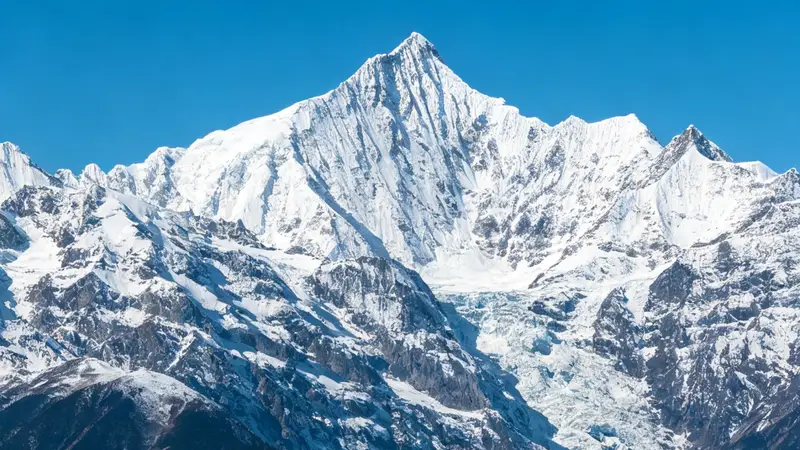
梅里雪山
雪神的仪仗队
横断山脉的腹地,在中国西南边陲,藏匿着一方令无数旅人魂牵的雪域圣境——梅里雪山。它并非单一座山峰,而是一片绵延150公里(length)的雪山群,地处云南省迪庆藏族自治州德钦县,恰好镶嵌在世界自然遗产“三江并流”的核心地带。这里地处青藏高原东南边缘,是云南与西藏的交界处,平均海拔超过3500米(meters)。
梅里雪山国家公园Occupying an area of 960 square kilometers, this national park is a Grade 4A tourist attraction, with its main peak, Kawagarbo, standing at 6740 meters, the highest point in Yunnan Province. Kawagarbo is also a revered sacred mountain in Tibetan Buddhism. This "virgin peak," which remains unconquered by climbers to this day, presents an untouchable dignity combined with unpredictable weather, making it one of the most awe-inspiring natural wonders on Earth.
The name "Meili" originates from Tibetan and means "King of Medicinal Herbs," earning it the local name "Mountain of Medicinal Herbs." The entire snow massif comprises thirteen peaks exceeding 6000 meters in elevation, collectively known as the "Thirteen Peaks of the Prince." These thirteen snow summits, stretching from south to north, resemble an solemnly arrayed heavenly army, piercing the clouds. Hence, they are poetically and photographically dubbed the "Guard of the Snow God."
Among them, the five most prominent peaks each carry names and legends: at the southernmost end is the Goddess Peak (Menzhum Peak) at 6054 meters, graceful and slender like a young lady; adjacent is the Five Crowns Peak, resembling five Buddhist crowns, solemn and majestic; and the General Peak appears as a warrior in armor, valiant and commanding.
At the center, Kawagarbo Peak is the heart of the snow range. Its pyramidal cone, bathed in the morning and evening light, exhibits near-perfect geometric beauty. Glaciers that never melt year-round cascade from the summit, refracting a sapphire hue under the sun; the northernmost peak, No Head Peak, remains perpetually shrouded in clouds, adding to its mystique. When these thirteen peaks align against a clear sky, their sheer scale creates a visual impact that leaves observers breathless.
The most enchanting view of Meili雪山 is the famed "Sunlit Golden Mountain." In winter and spring, when the sun first breaks over the mountains at dawn, its rays strike Kawagarbo's peak, instantly turning the white summit into a blazing crimson. As the sun rises higher, the golden light flows down the peak, sequentially illuminating the surrounding peaks, as if the entire snow range is adorned in a moving gold, magnificent and sublime.
The best time to witness this natural spectacle is between January and May each year, when the plateau enjoys clear weather, crisp air, and transparent atmosphere, greatly increasing viewing success compared to the rainy seasons of summer and autumn.
Beyond the stunning snow peaks, Meili雪山 also boasts diverse geological landscapes. The most famous is the Mingyong Glacier, originating from Kawagarbo, the largest valley glacier in Yunnan with the lowest terminal elevation in the world, a rare low-latitude, low-altitude monsoon marine glacier.
Along the pedestrian boardwalk, visitors can get close to the glacier's massive ice walls, deep crevices, and glistening ice spires. These blue-hued glacial relics seem to whisper tales of Earth's climatic evolution.
Another must-see natural wonder is the Golden Sand江大湾. The Golden Sand江, flowing through Deqin County, forces a nearly perfect "U" bend when obstructed by mountains, with a canyon elevation of 2000 to 3000 meters. From the viewing platform, the murky river twists like a dragon, a breathtaking spectacle.
Hidden within the snows lies the isolated paradise of Shangri-La village. This Tibetan village with fewer than twenty households sits in a 3000-meter-altitude high-altitude basin, surrounded by snow peaks and virgin forests. A stream murmurs before the village, prayer flags flutter behind, and in the morning mists, it resembles a fairyland.
From Shangri-La, several trails lead to nearby havens: the path to the Ice Lake traverses dense forests where the lake, formed by glacier meltwater, mirrors the surrounding snow mountains; the route to the Sacred Waterfall is even more sacred, as the waterfall cascades from the cliff of Goddess Peak. Tibetan Buddhists believe that bathing here washes away sins and grants blessings. On sunny days, double rainbows often grace the waterfall, breathtakingly beautiful.


